


Wisdom teeth are among the common reasons why people seek dental care, particularly when they cause pain, inflammation, swelling, or problems during eruption. Wisdom teeth, also known as third molars, are the last teeth to develop at the back of the mouth. They typically begin to emerge between the ages of 18 and 25, although the timing varies from person to person. Some wisdom teeth may erupt earlier or later, while others may never emerge.
Most adults have four wisdom teeth: two in the upper jaw and two in the lower jaw. However, some people develop fewer than four or do not develop wisdom teeth at all.
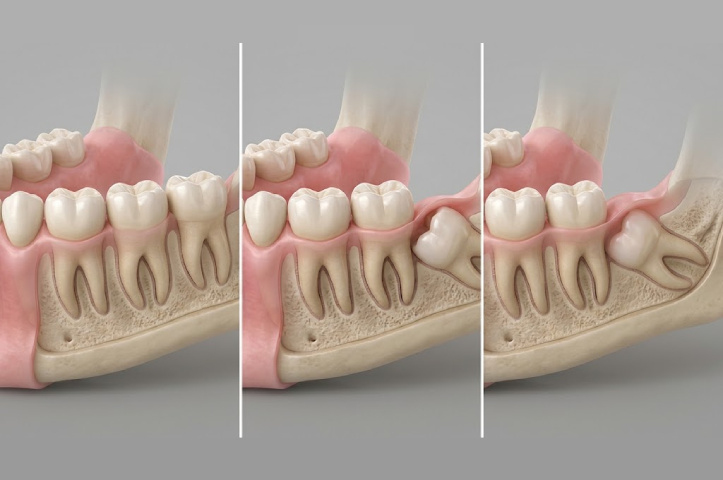
Depending on their position and eruption pattern, wisdom teeth can be classified into three main types:
Fully erupted wisdom teeth: Teeth that have emerged completely through the gum and are visible in the mouth.
Impacted wisdom teeth: Teeth that remain trapped beneath the gum tissue or within the jawbone because they cannot erupt normally.
Partially erupted wisdom teeth: Teeth that have emerged only partly, with some portion remaining covered by gum tissue or trapped beneath the surrounding structures.
In this article, Daryaye Noor Dental Clinic discusses the causes of wisdom tooth pain, common symptoms, when extraction may be necessary, how impacted wisdom tooth surgery is performed, and the potential risks and treatment options.
Wisdom Tooth Pain: Causes and Symptoms
Pain, swelling, and inflammation around a wisdom tooth are among the common reasons for seeking dental evaluation. These problems are more likely to occur when there is insufficient space for the tooth to erupt properly or when it emerges only partially.
A partially erupted wisdom tooth can create a space beneath the surrounding gum tissue where food particles and bacteria accumulate. This may lead to inflammation and infection, particularly around the gum flap covering part of the tooth.
Common problems associated with wisdom teeth include:
Inflammation of the gum tissue surrounding the tooth, known as pericoronitis.
Tooth decay affecting the wisdom tooth or the adjacent second molar.
Gum inflammation and periodontal problems around neighbouring teeth.
Dental abscesses or localized infections in some cases.
Damage to the roots or supporting structures of the adjacent second molar.
Development of cysts associated with impacted teeth in certain cases.
The symptoms and their severity vary between individuals. Some people experience noticeable pain and swelling, while others may have impacted wisdom teeth without experiencing any symptoms.
Where Can Wisdom Tooth Pain Spread?
One common concern among patients experiencing wisdom tooth pain is whether the discomfort can spread to the ear, throat, jaw, or other areas of the head and face.
Yes. Pain associated with wisdom tooth problems may be felt in nearby areas because of the interconnected nerve pathways that supply the teeth, jaw, and surrounding facial structures.
Depending on the underlying cause, patients may experience discomfort in:
The teeth adjacent to the wisdom tooth.
The back of the jaw.
The ear on the affected side.
The muscles surrounding the jaw.
The temple or side of the head.
In some cases, inflammation may also be accompanied by swollen nearby lymph nodes, difficulty opening the mouth, or discomfort when chewing or swallowing.
However, earache, headaches, and throat pain are not necessarily caused by wisdom teeth. These symptoms can have several other underlying causes, so an appropriate clinical examination is necessary to identify their source.
.jpg)
Can Wisdom Teeth Affect Tooth Alignment?
Many people believe that wisdom teeth inevitably cause crowding or changes in the alignment of the front teeth. However, a direct causal relationship between wisdom tooth eruption and anterior dental crowding has not been conclusively established.
The presence of wisdom teeth alone is not a sufficient reason for extraction to create space for orthodontic treatment. Instead, the decision should be based on the tooth's position, its effect on neighbouring teeth, the presence of associated disease, and the patient's overall treatment plan.
How Long Does It Take for Wisdom Teeth to Erupt?
Wisdom teeth generally begin to erupt during the late teenage years or early twenties. However, the timing varies considerably between individuals and depends on factors such as jaw development, tooth orientation, and the amount of available space in the mouth.
The eruption process may take several months and can occur gradually. In some cases, a tooth may partially emerge and then stop progressing for a period of time.
During this process, patients may experience pressure, gum tenderness, pain, or swelling around the affected area. If the tooth erupts only partially, food debris and bacteria may become trapped beneath the gum tissue, increasing the risk of inflammation and infection.
It is important to understand that an unerupted or impacted wisdom tooth does not always require surgical removal. Some impacted teeth remain symptom-free and do not cause any associated disease. In such cases, a dentist may recommend regular clinical and radiographic monitoring rather than immediate extraction.
Wisdom Tooth Extraction and Impacted Wisdom Tooth Surgery
The method used to remove a wisdom tooth depends on its position, eruption status, root structure, and relationship with the surrounding anatomical structures.
If the tooth has fully erupted and can be accessed easily, it may be removed through a relatively straightforward extraction procedure using conventional dental instruments.
However, if the wisdom tooth is partially or completely impacted, a surgical procedure may be necessary to gain access to it. Depending on the complexity of the case, the surgeon may need to remove a small amount of surrounding bone or divide the tooth into smaller sections to facilitate removal and reduce pressure on adjacent structures.
Main Steps of Wisdom Tooth Surgery
Impacted wisdom tooth surgery generally involves the following stages:
1. Clinical examination and imaging: The dentist or oral surgeon examines the mouth and reviews appropriate dental X-rays to assess the tooth's position, root structure, and relationship with nearby anatomical structures, such as the inferior alveolar nerve or maxillary sinus.
2. Local anaesthesia: Local anaesthesia is administered to numb the treatment area and prevent pain during surgery. Sedation or general anaesthesia may also be considered in selected cases, depending on surgical complexity and the patient's medical needs.
3. Gum incision: If the tooth is covered by gum tissue, the surgeon makes an appropriate incision to expose the impacted tooth.
4. Bone removal or tooth sectioning: When necessary, specialized surgical instruments are used to remove a limited amount of surrounding bone or divide the tooth into smaller sections to make extraction easier.
.jpg)
5. Tooth removal and cleaning: The tooth is removed, and the surgical area is carefully cleaned to remove any remaining debris or tissue requiring treatment.
6. Wound closure: Stitches may be placed to reposition the gum tissue, protect the surgical site, and help control bleeding.
The duration of surgery depends on several factors, including the degree of impaction, the number and shape of the roots, proximity to nerves or the maxillary sinus, and the overall complexity of the procedure.
Laser-Assisted Wisdom Tooth Surgery
Lasers are used in certain dental and oral surgical procedures to assist with the treatment of soft tissues. Depending on the clinical situation, laser technology may be incorporated into the treatment protocol for wisdom tooth surgery.
However, it is important to distinguish between using a laser to treat gum tissue and using surgical instruments to remove the wisdom tooth itself. A laser is not a replacement for conventional surgical instruments required to remove impacted teeth, section teeth, or remove surrounding bone when necessary.
Diode Laser in Wisdom Tooth Surgery
A diode laser is used in selected soft-tissue procedures. It delivers concentrated light energy to a specific area and can assist the surgeon in making controlled incisions and managing gum tissue.
The appropriate laser type and settings depend on the procedure and the tissue being treated. Factors such as output power, temperature control, tissue response, and appropriate safety measures must be considered.
Low-Level Laser Therapy After Wisdom Tooth Surgery
Low-Level Laser Therapy (LLLT), also known as photobiomodulation, is different from the lasers used to make surgical incisions.
This type of laser therapy has been investigated as a supportive treatment for certain postoperative symptoms following wisdom tooth surgery, including pain, swelling, and limited mouth opening.
Some clinical studies have reported beneficial effects, but the results vary depending on the treatment protocol, laser settings, and individual clinical conditions. Current evidence is not sufficiently conclusive to guarantee the same benefits for every patient.
Therefore, low-level laser therapy should not be considered a replacement for local anaesthesia or conventional surgical care. Nor can it guarantee the prevention of infection or faster tissue healing in every case.
Wisdom Tooth Surgery by an Oral and Maxillofacial Surgeon
While some wisdom teeth can be removed through a relatively simple extraction, other cases require more complex surgical assessment and treatment. This is particularly true for impacted, horizontally positioned, or unusually angled wisdom teeth, as well as teeth located close to important nerves or the maxillary sinus.
An Oral and Maxillofacial Surgeon is a specialist trained to assess and manage these conditions, taking into account the anatomical structures surrounding the tooth and the potential risks associated with surgery.
A comprehensive preoperative assessment generally includes:
The position and degree of impaction of the wisdom tooth.
The number, shape, and curvature of its roots.
The proximity of the roots to the inferior alveolar nerve.
The relationship between upper wisdom teeth and the maxillary sinus.
The condition of the adjacent second molar and surrounding bone and gum tissue.
Careful examination, appropriate imaging, and selection of a suitable surgical technique can help reduce the risk of complications. However, the level of risk varies depending on the individual case.
Surgical Removal of Impacted Wisdom Teeth
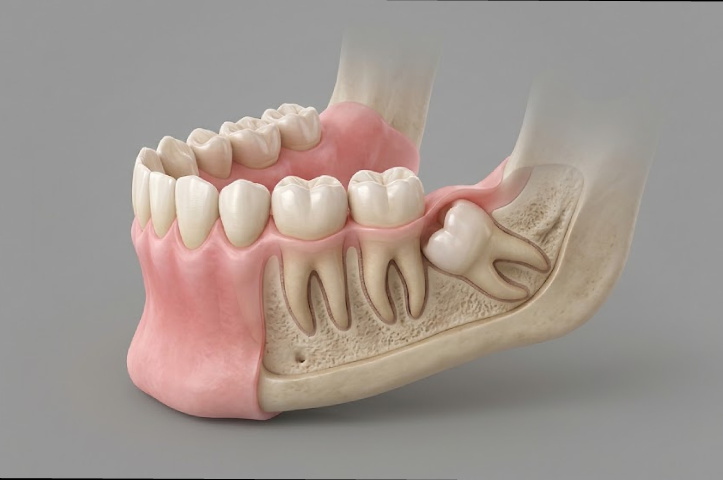
An impacted wisdom tooth is a tooth that cannot erupt normally because of a physical obstruction, insufficient space, or an unfavourable eruption direction.
Depending on its position, an impacted wisdom tooth may be classified as vertical, horizontal, or angled towards the adjacent second molar or the back of the jaw.

Register your opinion